
Artivisme: art, action politique et résistance culturelle
By Stéphanie Lemoine, Samira Ouardi. Quel art, quelle action politique possibles dans une société vouée au marché ? À cette double question, certains artistes et activistes répondent d'un pas de côté : en dehors des disciplines instituées et des routines protestataires, ils inventent des mani��res d'agir et de créer qui se nouent à l'articulation de la vie, de la performance, de la fête et du jeu. De même que le queer pose l'existence d'un troisième genre par delà féminin et masculin, de même l'artivisme suggère qu'il existe un troisième terme entre esthétique et politique. C'est l'art festif des collectifs décidés à réenchanter la vie, l'utopie des squats et des zones d'autonomie temporaire, la fronde libertaire des hackers et artistes du Net. Ce sont les détournements du Critical Art Ensemble, de Banksy et du Billboard Liberation Front, les sabotages joyeux de la guérilla pâtissière et des Yes Men, les infiltrations de JR, les performances de Steven Cohen ou Oreet Ashery, les prêches de Reverend Billy... Toutes ces pratiques, dont l'enjeu est d'opposer l'imagination et la créativité à l'ennui, la liberté d'action à la surveillance généralisée, la révolte collective au repli individuel, s'inscrivent dans une galaxie sans frontières... Published by Editions Alternatives in 2010. ISBN: 9782862276588.
Related Items
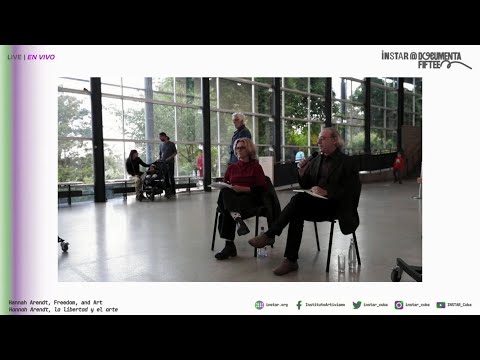
Hannah Arendt, libertad y el arte Huéspedes: Olivia Guaraldo Especialista en el pensamiento de Hannah Arendt y el feminismo contemporáneo, es profesora de Filosofía Política en la Universidad de Verona Roger Berkowitz AD Centro Hannah Arendt de Política y Humanidades en Bard College, Profesora de Política, Filosofía y Derechos Humanos en Bard College La acción política requiere que uno abandone el anonimato y la seguridad de la vida privada y se arriesgue a ser visto y juzgado en el mundo. Actuar en política es buscar dar sentido al mundo, por eso Arendt escribe: “El valor es indispensable porque en política no está en juego la vida sino el mundo”. En esta sesión nos preguntamos qué significa actuar con valentía en nombre del mundo común.
2023

Aprendizaje e imaginación política para todas las vidas Invitada: Suset Sánchez Lic. en Historia del Arte Tomando como punto de partida el pensamiento de la filósofa catalana Marina Garcés y sus ideas en torno a las formas y problemas del aprendizaje y la educación como pilares a partir de los cuales proyectar la vida en común en las sociedades contemporáneas, nos aproximaremos a la propuesta metodológica del Instituto de Artivismo Hannah Arendt para construir un proyecto de alfabetización cívica en Cuba.
2023

Prácticas expandidas autónomas Invitados: Marianela Boán Coreógrafa, bailarina y profesora Víctor Varela Director de teatro Mariela Brito Actriz Nelda Castillo Directora de teatro Lynn Cruz Actriz Tania Bruguera Artista, activista y directora de INSTAR Sandra Ceballos Artista Moderado por: Ileana Dieguez Investigadora y escritora La experiencia encarnada es un término utilizado por las teóricas del pensamiento situado, Donna Haraway particularmente, para validar el lugar de habla desde el cuerpo y la experiencia vivida. Desde ese lugar de enunciación queremos propiciar el diálogo entre quienes han sido protagonistas de prácticas autónomas que han apostado al ejercicio de un pensamiento libre e independiente en un medio de excesivo control social, intelectual, afectivo y humano.En la búsqueda de referentes que nos ayuden a pensar más allá de nuestra condición insular, deseamos explorar las ideas de Hakim Bey en torno a las “zonas temporalmente autónomas” y las “comunidades intencionales” para reflexionar las redes de información que se fueron tejiendo en Cuba como alternativas a los sitios y formas de producción institucionales. Interesa discutir la posibilidad de pensarlas como generadoras de poéticas que ancladas en situaciones y materialidades obstaculizadoras sentaron las bases de prácticas independientes capaces de articular voces y cuerpos que se reconocen en otros modos de hacer, generalmente no permitidos y que por ello mismo devinieron alegales, revulsivas, disidentes, y por qué no: independientes.
2023

La transgresión de la institución como parte del pensamiento artístico desde los años 70 con Taiyana Pimentel. Directora y Curadora en Jefe en Museo de Arte Contemporáneo de Monterrey.
2023
By Leslie L. Robinson. Artivism is a creative and youthful way of being, doing and seeing in the world that hinges on an explicit commitment to intervening in personal/collective circumstances toward change. Artivists respond to injustices by engaging any, and often multiple, artistic means in a shared effort to 'create for a better world'. But what are the challenges of belonging to a community of artivists while also seeking to become part of an academic community? What does it mean to be an artivist in a context premised on individual achievement and dominated by textual modes of expression? And how might artivism be enhanced by the kind of deep and sustained reflection made possible by the privilege of academic study? This dissertation aims to create a conceptual inter-space for the coming together of two worlds apart: artivism and academia. I address two main questions: (1) how can artivism mobilize and legitimize under-represented youth responses to the asymmetrical global conditions that shape our everyday lives? And, (2) how can artivist modes of inter-action and expression offer new responses to the asymmetrical global conditions that shape University life? When I began my doctoral degree I had recently completed co-research with youth in Uganda. We co-designed a series of community murals in response to youth identified concerns including HIV/AIDS and prostitution. I became part of artivists 4 life, a group interested in creating a sustainable space of resistance, and as it turns out, our work is never finished. I was thus driven to pursue a doctoral degree through a desire to continue supporting the collective's shared efforts of "creating for a better world" (artivists 4 life motto). Yet, through my experiences as a doctoral student I began observing many barriers to engaging in artistic, youth-driven co-research situated in Africa. Through the observation that certain knowledges and ways of knowing are undermined in the academy, my initial objective of doing co-research with artivits 4 life was no longer enough. I became obligated to simultaneously re-politicize creative co-research to respond more adequately to the conditions of global coloniality and the unequal power relations it manifests in the academy--across knowledge systems, race, culture, class, gender and other differences. This co-research is guided by the understanding that modernity is co-constituted by a colonial logic that serves to divide human beings and societies into 'less-than' and 'more-than' derivatives through the subjugation of knowledges and subjectivities in relation to their proximity to the hetero-Euro-centric norm. For decolonial thinkers, hope for an egalitarian pluriversal society lies in the struggles of the marginalized, the acceptance of their agency, and the willingness to be guided by their perspectives. Each piece of this dissertation embodies an artivist consciousness that allows for constant re-adaptation to the broader questions of decolonial struggle that shape the realities of those with whom I collaborate. Circumstances addressed include youth unemployment, sexual exploitation, epistemic racism and the increasing corporatization of academia, particularly as these precarious conditions impact upon members of artivists 4 life, myself inclusive. Artivist inter-actions engage multiple forms of enunciation in the making of murals, comics, performances, creative writing, and any other creative means necessary to break from the pervasive wiring of global coloniality and the wounds it inflicts upon us. These interventions work to re-conceptualize aesthetics, authorship and knowledge creation/dissemination in order to shift power. Throughout this dissertation fixed relations prescribed by modernity/coloniality--including the researcher-researched and the student-teacher--are re-imagined through the reconnection of creative practices to collective action. Through creative research with Ugandan youth and in one instance with fellow graduate students, I engaged with communities to unveil the mechanisms that sustain asymmetrical relations produced by modernity/coloniality in the places We/I dwell. Focusing on the structures of societal control serve to open new imaginaries for transcending power differentials by moving away from cultural mimicry toward the co-creation of new social formations not yet in existence. Emergent artivist epistemes and actions for such transformation require adjacent spaces to the academic project in order to support the co-creation of more adequate modes of inter-human contact premised on community self-determination. Overall, this dissertation enacts tactics for undoing disciplinary norms and other intellectually colonizing tendencies by allowing creative reflection/artistic action to flourish through an ethical commitment to making visible the invisible. Published in 2015.
2015